
Takikomi Gohan with Chicken - Kashiwa Meshi
- Kurumi Hayter
- Jan 8
- 4 min read


In Japanese, this Takikomi Gohan with Chicken is known as "kashiwa meshi". It hails from the city of Fukuoka which is on the island of Kyushu. In the local dialect, "kashiwa' means chicken and "meshi" means rice, so the direct English translation - chicken rice - although it seems quite prosaic is 100% accurate!
But "kashiwa" is also used to describe the leaf of the local species of oak tree. So how did it come about that the word also means "chicken"? Well, the background to the dish "kashiwa meshi" is quite interesting and forms a small part of Japanese history in the 1,000 + years when the eating of meat was prohibited for various reasons including the beliefs of the Buddhist religon and the scarcity of food resources in Japan. Like all prohibitions, the ban on eating meat in Japan was not universally observed. In order to hide their illegal consumption of meat, it is said that the locals developed a coded language where meats were known by the names of flora to fool the authorities into thinking that the dishes being eaten contained no meat. As the local variety of chicken sported feathers that had an auburn tint to them, chicken meat became known by the name of the brown leaves of the oak tree, ie "kashiwa." Thus, the dish "kashiwa meshi" was born.
Other meats were also given coded names too - pork became "botan" which is the local dialect for the peony flower. Deer meat was known by the moniker " momiji" which is the Japanese name for the acer shrub. Likewise, horse meat became known as "sakura" meaning cherry tree.
Nowadays, there is no need to disguise the meat content of any dish in Japan. But still the name Kashiwa Meshi lives on and has certainly stood the test of time. It continues to be a big favourite especially so in the form of an "eki ben" or station lunch - the kind of thing travellers buy from the railway station during their travels.
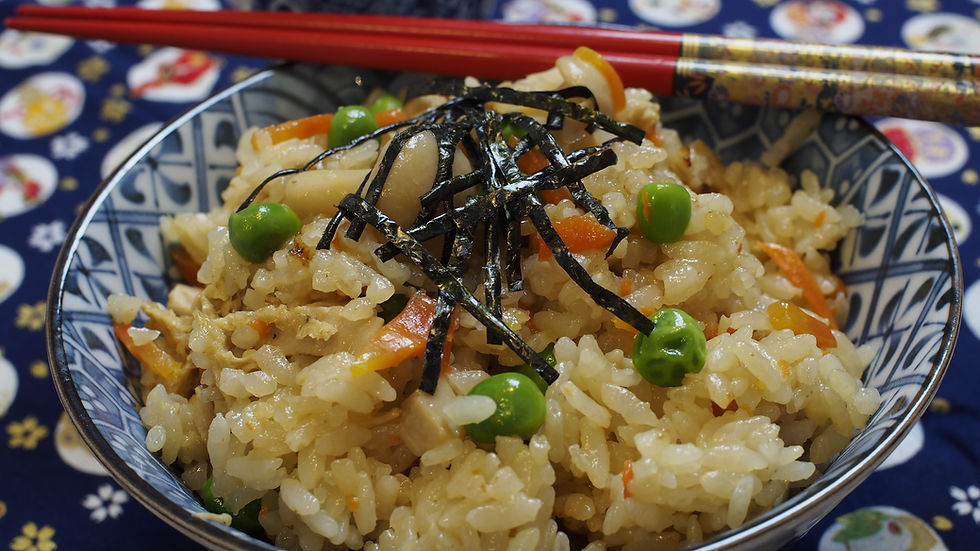
This particular recipe was supplied by my good friend and collaborator Yumiko Nikaido who lives in Tokyo. It features - yes, you guessed it - chicken and rice - along with carrot, burdock root (what the Japanese call "gobo") with a topping of spring onion, a little crished walnut and a sprinkle of white sesame seeds. Flavour wise, the mix combines soy sauce, mirin, Japanese sake and a little sugar. The chicken and vegetables are stir fried in sesame oil to give a lovely, slightly nutty flavour. Once the chicken and vegetables are ready, the whole lot is gently stirred into a pot of freshly steam Japanese rice, infusing it with lovely, rich umami and nutty flavours. As dishes go, it's easy to prepare and provides a filling and nutricious meal - what's not to like about that!
If you want to learn more about how to make Takikomi Gohan with Chicken / Kashiwa Meshi, you can find the Youtube video by clicking Takikomi Gohan with Chicken or by scrolling to the bottom of the page. The written recipe is just below.
Happy cooking! Kurumi XXXX.
ingredients:
makes 2 generous servings:
2 cups, fresh Japanese rice (150g x 2 dry weight)*
60g / 2.1oz burdock root
60g / 2.1oz carrot, peeled
200g / 7oz skinless and boneless chicken thighs (or chicken breast if preferred)
2 spring onions, rinsed
2 tbsp walnuts
1 tbsp sesame oil
1 tsp Japanese sake
1/2 tbsp sugar
50ml / 1.7floz soy sauce
50ml / 1.7floz mirin
toasted white sesame seeds
* this equates to approx 600g / 21oz cooked Japanese rice if you already have some prepared
how to:
Rinse or rice well and cook using your preferred method. I used my rice cooker for this recipe but it also works well if you cook your rice in a saucepan.
To prepare the vegetables, scrape off a thin layer of the skin of the burdock root. I use the back of my kitchen knife to do this. Next, cut the root into about 3cm / 1 inch pieces. Set each piece on its end and cut into slices then cut the slices into matchsticks. Burdock root can taste a little bitter and to reduce this, put the matchsticks into a bowl of water for 5 - 10 minutes, then drain.
Next, cut the peeled carrot into 2 or 3 pieces depending on the length of the carrot, then slice thinly and cut into matchstickes like you did with the burdock root.
Finely slice the rinsed spring onion. Set this aside for a topping.
Next, remove any fat from the chicken thighs. Cut into small bite size pieces.
Heat the sesame oil in a medium frying pan. Add the chicken, burdock root and carrot. Fry over a medium heat until the chicken has coloured.
Meanwhile, lightly crush the walnuts.
Returning to the frying pan, add the Japanese sake, sugar, soy sauce and mirin to the chicken and vegetables. Simmer over a low / medium heat for 7 - 8 minutes or until the liquid has almost evaporated.
Add the crushed walnuts and stir well, before turning off the heat.
Add the fried chicken and vegetable mixture to the rice. Gently mix everything together until the rice has coloured.
To serve, heap generously into serving bowls, top with sliced spring onion and sprinkle the sesame.

Comments